
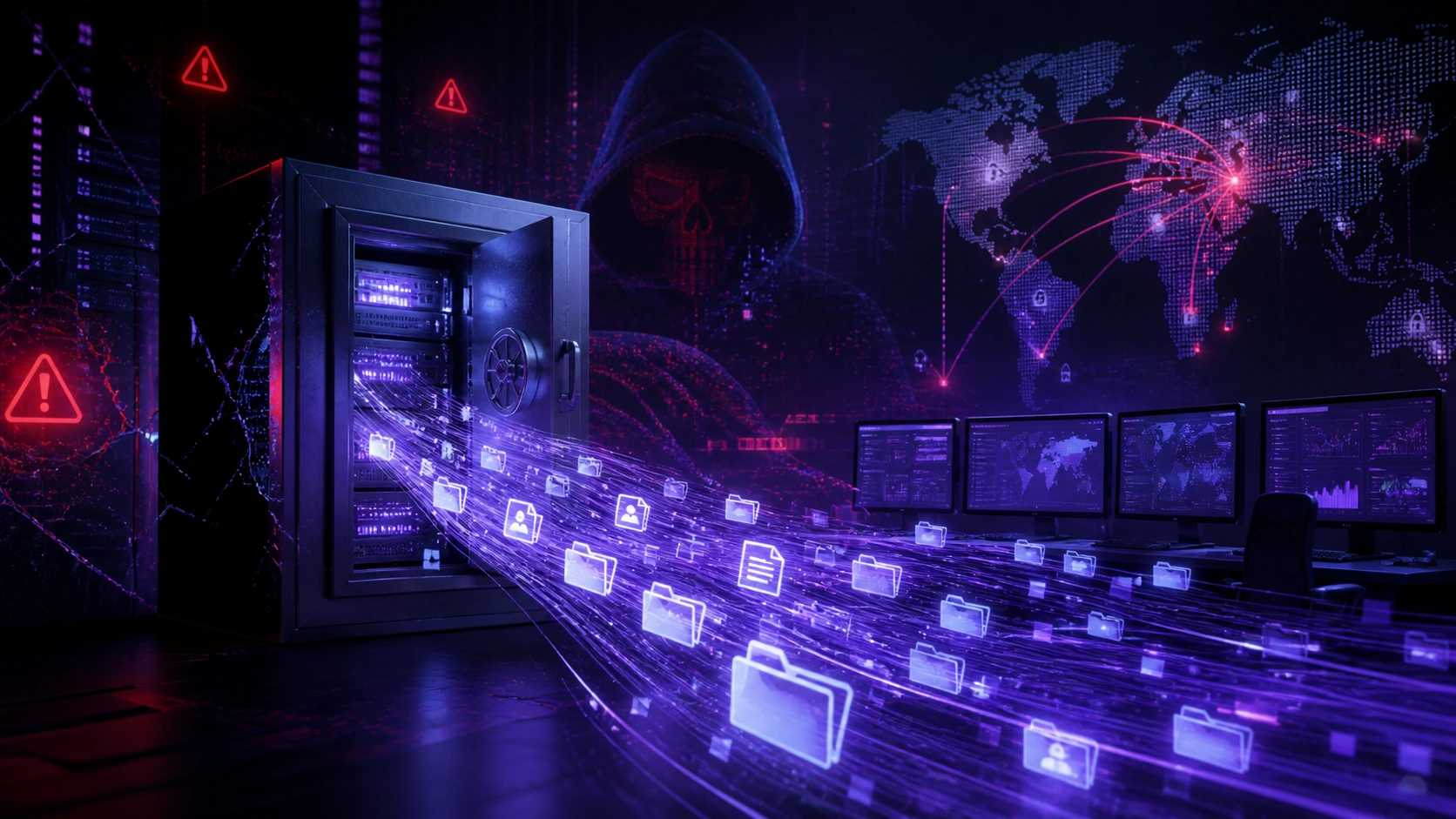
Ransomware data theft is no longer just a side effect of cybercrime. It has become the main event, the pressure point, and the business model that keeps modern ransomware groups alive even when companies improve backups, recovery systems, and downtime planning. In Q1 2026, ransomware activity stayed steady instead of exploding dramatically, but that stability should not be mistaken for safety. The real shift is happening underneath the surface, where threat actors are moving away from old-school disruption and leaning harder into stealing sensitive information before victims even know something has gone wrong. This is the kind of cyber risk that feels quieter at first, but can hit harder later because the damage follows a business long after systems come back online.
Ransomware Data Theft Becomes the Main Threat
For years, the typical image of ransomware was simple: a company wakes up, screens are locked, files are encrypted, and operations grind to a halt. That version still exists, but it no longer tells the full story of the modern ransomware economy. Today, attackers are not just trying to break systems; they are trying to extract value from the data sitting inside those systems. Ransomware data theft gives criminals more leverage because stolen files can be used for blackmail, public leaks, regulatory pressure, customer panic, and even follow-up fraud campaigns. In this new phase, the scariest part is not always the ransom note on the screen, but the invisible movement of data leaving the network before anyone notices.
The Q1 2026 picture shows a cybercrime market that is becoming more disciplined, more strategic, and more focused on monetization. Ransomware groups understand that many organizations now have stronger backup routines, better endpoint tools, and more practiced incident response teams. Because of that, simply encrypting files is not always enough to force payment. If a company can restore systems quickly, the attacker loses bargaining power. But if the attacker has already stolen contracts, employee records, financial documents, source code, customer data, or internal emails, the victim still faces a serious crisis even after technical recovery begins.
This is why data exfiltration has become the center of modern extortion. It turns ransomware from a downtime problem into a reputation, compliance, and trust problem. A business can restore a server, but it cannot easily restore public confidence once sensitive information is exposed. A hospital can bring its systems back online, but it still has to answer patients whose private data may be circulating outside its control. A manufacturer can restart production, but leaked supplier contracts or product designs can create commercial damage that lasts far beyond the first week of the incident.
The shift also changes how organizations need to think about defense. Traditional ransomware planning often focused heavily on backup recovery, disaster response, and business continuity. Those are still important, but they are not enough when attackers are prioritizing stolen data over simple disruption. The new question is not only “Can we recover if our systems are locked?” but also “Can we stop sensitive data from leaving in the first place?” That question is now central to cybersecurity risk management, especially for businesses that hold large volumes of personal, financial, legal, industrial, or intellectual property data.
Why Q1 2026 Still Feels Dangerous
At first glance, steady ransomware activity might sound like good news. It suggests that the threat landscape is not suddenly spiraling out of control in terms of raw attack volume. But cybersecurity trends are rarely that simple, because the number of attacks is only one part of the story. If attackers become more efficient, more selective, and more focused on high-value data, then stable activity can still mean rising impact. In Q1 2026, the bigger concern is not just how many attacks happened, but how those attacks are being shaped to create deeper pressure on victims.
Ransomware groups are behaving less like chaotic hackers and more like criminal businesses that understand market dynamics. They study which sectors are vulnerable, which victims are likely to pay, and which types of data create the most pressure. They know that legal departments fear regulatory exposure, executives fear investor backlash, and customers fear identity theft. This creates a layered extortion model where the attacker does not depend on one form of damage. Encryption may still be used, but stolen data gives the criminal group an additional weapon that is harder to neutralize.
This makes ransomware attacks more psychologically intense for victims. When a company faces disruption, the first instinct is to restore operations as quickly as possible. When stolen data is involved, the crisis becomes more complicated because leaders must consider disclosure rules, customer notification, law enforcement, insurers, lawyers, media narratives, and long-term brand damage. The attacker benefits from that confusion. Every hour of uncertainty becomes part of the pressure campaign, especially when the threat group claims it will publish sensitive files unless payment is made.
The steady nature of ransomware activity also shows that cybercriminal groups are adapting rather than disappearing. Even after takedowns, arrests, sanctions, and public exposure, the ecosystem keeps regenerating. Affiliates move between groups, tools get recycled, leaked code gets reused, and new names appear after old brands become too risky. This is why ransomware remains one of the most persistent threats in enterprise cybersecurity. It is not just a malware problem; it is an underground service economy with roles, incentives, supply chains, and business logic.
Encryption Is No Longer the Whole Story
The old ransomware playbook relied heavily on encryption because locking files created immediate pain. A company could not access documents, databases, operational tools, or customer systems, which meant downtime became expensive very quickly. That model worked because many organizations were unprepared and backups were often incomplete, outdated, or connected to the same environment that attackers compromised. Over time, however, businesses got better at recovery. Attackers noticed that and adjusted their strategy.
Now, many ransomware incidents include some form of data theft before encryption happens, or sometimes even without major encryption at all. This approach is attractive to criminals because it reduces their dependence on technical disruption. If the victim has strong recovery systems, the stolen data still gives attackers leverage. If the victim refuses to pay, the group can threaten to leak the information publicly. If public pressure is not enough, attackers may contact customers, partners, employees, or journalists to increase the heat.
This is why double extortion ransomware has become such a defining phrase in modern cybersecurity. The attacker does not only deny access to data; they also threaten to expose it. In some cases, the model goes even further into triple extortion, where third parties connected to the victim are also pressured. A stolen customer database may become a tool for direct intimidation. A leaked vendor contract may become a reputational weapon. A private internal discussion may be framed in the worst possible way to damage trust.
The result is a more aggressive and more personal kind of cyberattack. It does not just target machines; it targets relationships. It targets confidence between companies and customers, between employers and employees, between suppliers and clients, and between public institutions and the communities they serve. That is why ransomware data theft is such a serious evolution. It shifts the battlefield from the server room to the entire trust ecosystem around an organization.
The Business Model Behind Modern Ransomware
Ransomware is often described as a technical threat, but its real strength comes from economics. Threat actors are constantly looking for ways to increase revenue, reduce risk, and maximize pressure on victims. Data theft fits that model because it creates multiple monetization paths from a single intrusion. Stolen information can be used for ransom demands, sold in underground markets, used for fraud, repurposed for phishing, or combined with other datasets for future attacks. This makes every compromised environment a potential long-term revenue source.
The ransomware-as-a-service model also helps explain why the threat remains so persistent. In this structure, one group may develop malware, another may handle negotiations, another may provide infrastructure, and affiliates may carry out intrusions. This division of labor lowers the barrier to entry for cybercriminals who do not have elite technical skills but know how to find vulnerable targets. It also makes the ecosystem harder to dismantle because different parts can survive even when one brand is disrupted. In practical terms, ransomware behaves less like one gang and more like a flexible criminal marketplace.
For victims, this means attackers may be more organized than expected. Negotiation portals, leak sites, countdown timers, victim profiles, and proof-of-theft samples are all designed to create pressure. The experience can feel disturbingly professional because many groups have refined their process over years. They understand that fear, uncertainty, and urgency are powerful tools. They do not need to destroy a company outright; they only need to make payment feel like the fastest path out of chaos.
This is why ransomware prevention cannot be treated as a purely technical checklist. It must include business-level planning, legal preparation, executive training, employee awareness, and clear incident response decision-making. A company that has never discussed whether it would pay a ransom may freeze when the crisis arrives. A company that does not know where its sensitive data lives may struggle to understand the scale of exposure. A company that cannot communicate clearly during an incident may lose public trust even if its technical team performs well.
AI Makes Data Theft Faster and Harder to Spot
Artificial intelligence is now adding another layer to the ransomware story. Attackers can use automation to process stolen information faster, identify high-value files, improve phishing messages, and scale social engineering campaigns. This does not mean every ransomware group is using advanced AI in a futuristic way, but it does mean the tools available to criminals are becoming more efficient. Even simple automation can make a major difference when attackers are sorting through large amounts of stolen data. The faster they can understand what they stole, the faster they can weaponize it.
AI-driven workflows can also help threat actors personalize pressure. Instead of sending generic threats, criminals may analyze stolen emails, contracts, and internal documents to find sensitive topics. They can identify executives, legal issues, major clients, pending deals, or confidential projects. That context can make extortion more targeted and more convincing. In the world of ransomware data theft, information is not only stolen property; it becomes ammunition.
Defenders also face a visibility challenge because data theft is often quieter than encryption. Encryption tends to create obvious symptoms when files suddenly become inaccessible. Exfiltration may look like unusual traffic, strange archive creation, abnormal cloud activity, or unexpected access patterns. If monitoring is weak, attackers can move data out slowly enough to avoid triggering obvious alarms. This makes detection engineering, endpoint visibility, network monitoring, and identity controls more important than ever.
The AI factor also raises the stakes for data loss prevention. Companies need to understand not just where data is stored, but how it moves. They need policies that can detect suspicious transfers, unusual compression, unauthorized cloud uploads, and unexpected access to sensitive repositories. They also need to watch for shadow IT and unmanaged tools that employees may use without security oversight. Attackers only need one path out; defenders need to close as many unnecessary paths as possible.
Which Organizations Are Most Exposed
Every organization with valuable data is a potential target, but some sectors naturally face higher pressure. Healthcare, education, finance, government, manufacturing, legal services, and critical infrastructure all hold information that can create intense consequences if exposed. These sectors also often depend on uptime, which means disruption still matters even when data theft is the main focus. A hospital cannot pause patient care while debating ransom strategy. A school district cannot easily rebuild trust after student records are leaked.
Small and mid-sized businesses are also exposed because attackers know they may have weaker defenses. Many smaller companies hold sensitive customer information but lack dedicated security teams, mature monitoring, or tested incident response plans. They may use cloud tools, remote access systems, third-party vendors, and outdated infrastructure without full visibility. This creates a perfect environment for attackers looking for low-friction entry points. In many cases, a smaller business may be hit not because it is famous, but because it is accessible.
Large enterprises face a different kind of challenge. They often have more security tools, but they also have more complexity. Thousands of employees, multiple cloud environments, legacy systems, mergers, contractors, vendors, and global operations all expand the attack surface. A single weak identity, exposed credential, misconfigured server, or unmanaged endpoint can become the opening attackers need. For large organizations, the problem is not only buying security tools, but making sure those tools are connected, monitored, and understood.
This is why cyber resilience has become such an important concept. Resilience means assuming that some attacks will get through and preparing the organization to limit damage quickly. It includes prevention, detection, containment, recovery, communication, and learning after the incident. In the age of ransomware data theft, resilience also means reducing the amount of data attackers can access in the first place. The less unnecessary data a company stores, and the better it segments sensitive systems, the less leverage criminals may gain.
The Human Layer Still Matters
Even with advanced malware and AI-enhanced tools, humans remain central to ransomware risk. Phishing, stolen credentials, fake login pages, malicious attachments, and social engineering remain common pathways into organizations. Attackers know that people are busy, distracted, and often under pressure to respond quickly. A convincing message that appears to come from a vendor, executive, recruiter, or IT department can still open the door. Once credentials are stolen, attackers may move quietly before triggering the final stage of the attack.
This does not mean employees should be blamed every time an incident happens. Security culture works best when people are treated as part of the defense system, not as the weakest link to shame. Employees need realistic training, clear reporting channels, and tools that make safe behavior easier. If reporting a suspicious email feels complicated, people may ignore it. If security rules are impossible to follow, employees may find shortcuts that create new risks.
Executives also play a human role in ransomware readiness. Leadership teams must understand that cybersecurity is not only an IT budget line. It is a business continuity issue, a legal issue, a brand issue, and a trust issue. When ransomware hits, the decisions are rarely simple. Leaders may need to weigh operational recovery, public communication, regulatory notification, insurance requirements, and ethical questions around payment. Waiting until an attack is underway to have those conversations is a risky strategy.
Board-level awareness is especially important because ransomware has become a governance issue. Directors and executives should be asking how sensitive data is protected, how quickly suspicious exfiltration can be detected, how often recovery plans are tested, and whether third-party risks are being reviewed. They should also ask whether the company understands its most critical assets. If an organization cannot define what data would cause the most damage if stolen, it cannot properly defend it.
How Companies Should Respond in 2026
The first step is accepting that ransomware defense has changed. Backups remain essential, but backups alone do not solve ransomware data theft. A company may restore systems perfectly and still face legal, financial, and reputational fallout from stolen information. That means security programs need to prioritize stopping exfiltration, reducing unnecessary data exposure, and detecting suspicious behavior earlier in the attack chain. Recovery is still critical, but prevention and containment need equal attention.
Organizations should start with data mapping. It sounds basic, but many companies do not have a clear view of where sensitive information lives. Customer records may sit in production databases, exported spreadsheets, shared drives, cloud storage, email inboxes, and legacy systems. Attackers love this kind of sprawl because it gives them more places to search. Strong data security begins with knowing what exists, where it is stored, who can access it, and whether it still needs to be retained.
Identity security is another major priority. Many ransomware intrusions depend on compromised credentials, weak passwords, reused logins, exposed remote access, or poor privilege management. Multi-factor authentication should be standard, but it must also be implemented carefully to resist fatigue attacks and bypass attempts. Privileged accounts should be limited, monitored, and separated from daily-use accounts. Access should follow the principle of least privilege, meaning users get only what they need and nothing more.
Network segmentation also matters because it limits how far attackers can move after gaining access. Flat networks give intruders room to explore, escalate, and collect data across systems. Segmented environments create barriers that make lateral movement harder and easier to detect. Critical systems, backups, sensitive databases, and administrative tools should not be casually reachable from every endpoint. In ransomware defense, slowing attackers down can be just as important as blocking them outright.
Detection Must Focus on Data Movement
Modern ransomware defense needs to watch for signs of data staging and exfiltration. Attackers often gather files, compress them, rename them, move them to temporary locations, and then transfer them out through cloud services, encrypted channels, or attacker-controlled infrastructure. These behaviors can create signals before the final ransom demand appears. Security teams should monitor unusual file access, large outbound transfers, abnormal use of archiving tools, unexpected cloud uploads, and suspicious access outside normal business patterns. The goal is to catch the theft phase before it becomes an extortion crisis.
Endpoint detection and response tools can help, but they should not work in isolation. Logs from identity systems, cloud platforms, email gateways, network tools, and data repositories need to be connected in a way that gives analysts context. A single alert may not look serious on its own. But when combined with unusual login activity, privilege escalation, archive creation, and outbound traffic, the picture becomes much clearer. This is where mature threat detection becomes a major advantage.
Companies should also test their incident response plans with realistic ransomware scenarios. A tabletop exercise should not only ask whether systems can be restored. It should ask what happens if payroll data is stolen, if customer contracts are leaked, if journalists receive samples, or if attackers contact clients directly. These uncomfortable questions are exactly why preparation matters. A plan that only covers technical recovery is incomplete in 2026.
Communication is part of the defense as well. During a ransomware incident, silence can create panic, but rushed communication can create confusion. Organizations need pre-planned roles for legal, communications, IT, executives, customer support, and external partners. They need to know who approves statements, who contacts regulators, who talks to law enforcement, and who handles customer questions. Clear communication does not erase the incident, but it can reduce chaos and preserve trust.
The Bigger Trend: Cybercrime Is Becoming Data-Centric
The ransomware shift reflects a broader cybercrime trend: data is the target, the product, and the leverage. Criminal groups understand that businesses run on information, and that sensitive information can be monetized in many ways. This is why ransomware data theft overlaps with identity theft, business email compromise, insider risk, supply chain attacks, and dark web markets. The boundaries between cybercrime categories are becoming less clean. One intrusion can produce multiple forms of harm.
This also means organizations need to think beyond malware names and ransomware brands. Focusing only on which group is trending can be useful for threat intelligence, but it does not replace basic security discipline. Many attackers still exploit familiar weaknesses: unpatched systems, exposed services, weak credentials, poor monitoring, excessive access, and unmanaged data. The names on leak sites may change, but the underlying opportunities often look painfully familiar. Good cyber hygiene may sound boring, but it remains one of the strongest foundations against ransomware.
Regulatory pressure is likely to keep growing because stolen data affects real people. Customers, patients, students, employees, and citizens all bear the consequences when organizations fail to protect information. Governments and regulators are increasingly interested in how companies manage cyber risk, disclose incidents, and protect critical services. That makes ransomware not only a security problem, but a compliance and accountability problem. Businesses that treat cybersecurity as optional may find the cost of neglect rising quickly.
There is also a cultural shift happening inside companies. Cybersecurity used to be seen by many teams as a background function, something handled by technical people behind the scenes. Ransomware has changed that perception because attacks now affect operations, legal exposure, public image, customer relationships, and revenue. The most prepared organizations are the ones that make cyber risk part of everyday business planning. They do not wait for a crisis to discover who owns the problem.
Conclusion: The New Ransomware Reality
Ransomware data theft is now one of the clearest signs that cybercrime has matured into a pressure-based business model. Q1 2026 shows that even when ransomware activity appears steady, the threat can still evolve in more dangerous ways. Attackers are no longer relying only on disruption because stolen data gives them deeper leverage and longer-lasting impact. The result is a ransomware landscape where recovery is important, but stopping data from leaving the network is even more urgent. For organizations, this is the moment to update old assumptions before attackers exploit them.
The companies that handle this era best will be the ones that think beyond backups and start treating data protection as a core survival issue. They will map their sensitive information, reduce unnecessary access, strengthen identity controls, monitor data movement, train employees realistically, and rehearse crisis decisions before they are forced to make them under pressure. They will understand that ransomware is not just about locked files anymore. It is about trust, exposure, negotiation, and control. In 2026, the smartest cybersecurity strategy is not only to recover fast, but to make sure attackers never get the data they came for in the first place.