

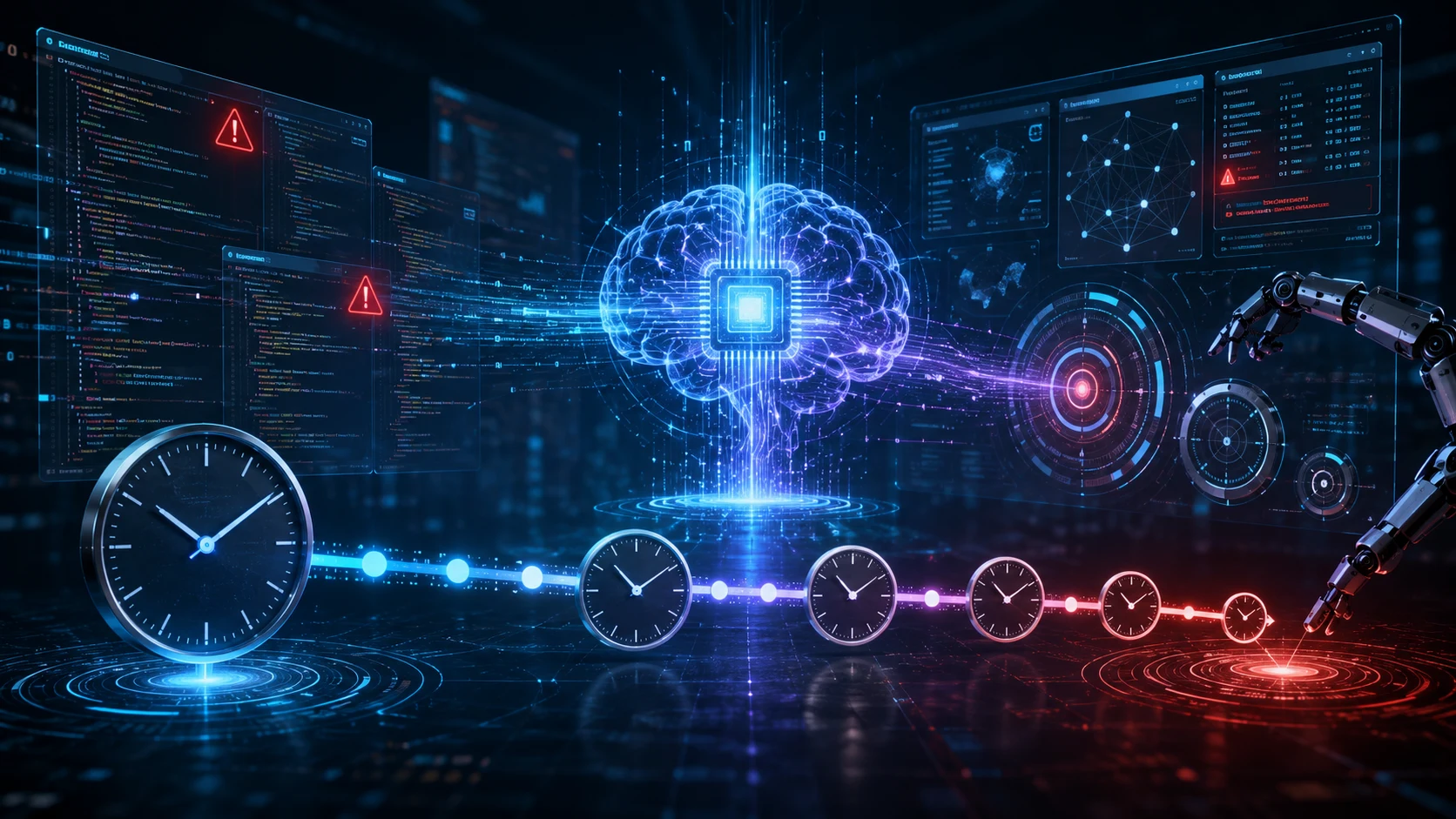
The cybersecurity world has been moving fast for years, but Mythos Preview feels like the moment when the clock suddenly started spinning harder. For a long time, security teams talked about N-day vulnerabilities as serious but somewhat manageable problems because defenders usually had a small window to patch, test, prioritize, and breathe before attackers turned public disclosures into working exploits. That window is now under pressure from frontier AI systems that can read advisories, understand code behavior, connect technical clues, and accelerate exploit research in ways that used to require seasoned human specialists. The phrase “N-day to N-hour” sounds dramatic, but it captures the new reality facing enterprise security teams, cloud defenders, software vendors, and anyone responsible for keeping internet-facing systems alive. In this new phase, Mythos Preview is not just another AI story; it is a signal that vulnerability management is becoming a race against machine-speed interpretation.
The core idea behind this shift is simple, but the implications are massive. An N-day vulnerability is a flaw that has already been disclosed publicly, often with enough technical detail for defenders to understand the risk and deploy a patch. Historically, attackers still needed time to reverse-engineer fixes, build reliable proof-of-concept code, test it against real environments, and turn it into something useful for intrusion or ransomware campaigns. That process could take days, weeks, or even longer depending on the complexity of the bug and the target software. With AI exploit development entering the scene, the timeline can collapse because a capable model can help automate parts of analysis that once required deep manual focus.
Why Mythos Preview Matters in AI Exploit Development
Mythos Preview matters because it points to a future where the most dangerous gap in cybersecurity may not be between discovery and disclosure, but between disclosure and weaponization. Security teams already know that patching is hard, especially inside large organizations with legacy systems, vendor dependencies, compliance checks, change windows, and fragile production environments. The problem is that attackers do not wait for internal approval chains, and AI-assisted workflows can make that imbalance more brutal. When a new vulnerability becomes public, the question is no longer just whether attackers will understand it. The sharper question is how quickly automated systems can turn that information into a working attack path.
This is where the “N-hour” idea becomes more than a buzzword. If a model can analyze a fresh advisory, inspect surrounding code, infer the root cause, generate test cases, and help shape a proof of concept within hours, defenders lose the comfort of delayed exploitation. Even organizations with mature vulnerability programs may struggle because many patching processes are still built around weekly or monthly rhythms. That rhythm made more sense when exploit development required more manual labor and public weaponization was less immediate. In the age of AI-driven vulnerability research, the old patch calendar starts looking dangerously slow.
The Difference Between Zero-Day and N-Day Risk
To understand why this story matters, it helps to separate zero-day and N-day risk. A zero-day vulnerability is unknown to the vendor or has no available fix at the time it is being exploited, which makes it especially dangerous because defenders have limited options. An N-day vulnerability, by contrast, is already known, documented, and often patched, but it remains dangerous because many organizations do not apply fixes immediately. In real-world security, N-day exploitation is extremely common because attackers do not need to discover brand-new flaws when thousands of exposed systems are still running vulnerable software. That makes the Vulnerability category of cybersecurity less about awareness alone and more about response speed, asset visibility, and operational discipline.
The uncomfortable truth is that N-day bugs are attractive because they come with a roadmap. Once a patch drops, attackers can compare old and new code, read technical notes, study regression tests, and look for the exact logic that changed. In the past, that work required time, skill, and patience, especially for complex memory corruption bugs or kernel-level issues. AI systems can compress the research phase by acting like tireless assistants that summarize code, propose hypotheses, generate harnesses, and iterate quickly. That does not mean every model instantly becomes a master hacker, but it does mean the average time to useful exploitation can shrink in ways defenders cannot ignore.
How AI Changes the Tempo of Vulnerability Management
Traditional vulnerability management is built around triage. Teams collect alerts, score severity, map affected assets, check whether a patch exists, test compatibility, schedule deployment, and verify completion. That workflow still matters, but Mythos Preview shows why the tempo has to change for high-risk flaws. A vulnerability with public technical detail, broad deployment, remote exploit potential, and high business impact can no longer sit in a normal queue just because it has not yet appeared in active exploitation dashboards. In a machine-speed threat environment, waiting for confirmed exploitation may mean waiting until the first wave has already landed.
The biggest impact will probably be felt by organizations with sprawling software estates. Large enterprises often run multiple versions of browsers, operating systems, VPN appliances, cloud workloads, identity tools, middleware, and business-critical applications across regions and departments. Even when a patch exists, security teams may not know exactly which assets are exposed, which owners are responsible, or which systems can be patched without breaking operations. AI-assisted attackers benefit from that complexity because they only need one reachable weak point. Defenders, meanwhile, must discover and close every meaningful exposure before automation turns public knowledge into a real compromise path.
From Manual Exploit Craft to Machine-Assisted Research
The classic image of exploit development is a highly skilled researcher staring at assembly, source code, crash dumps, and debugger output until the vulnerability finally gives up its secrets. That image is still real, and human expertise remains essential, especially for reliability, targeting, stealth, and understanding complex systems. What is changing is the amount of early-stage research that AI can accelerate. A model like Mythos Preview can potentially help connect advisory language to code paths, suggest where input validation fails, and explain why a patch matters. That makes it easier for both defenders and attackers to move from “a vulnerability exists” to “this is how the flaw behaves.”
This does not mean every script kiddie suddenly becomes an elite vulnerability researcher overnight. Real exploitation still involves constraints, environment differences, mitigations, crash reliability, privilege boundaries, and operational risk. However, AI lowers the friction around understanding and experimentation, which is exactly where many security timelines used to slow down. The danger is not only fully autonomous exploitation, but also the way AI can multiply the productivity of people who already know what they are doing. When one skilled operator can move like a small team, the defensive backlog becomes even harder to justify.
Why Software Vendors Are Under New Pressure
Software vendors are also entering a more intense phase. In the past, a vendor could publish a patch and advisory, then depend on customers to apply updates over a reasonable period. That model is now strained because detailed disclosures can become fuel for automated vulnerability analysis. Vendors may need to rethink how much technical detail they release at each stage, how quickly they coordinate with major customers, and how they prepare detection logic before public disclosure. The challenge is balancing transparency with the reality that AI systems can consume public information faster than traditional threat actors ever could.
This does not mean vendors should hide everything, because secrecy can leave defenders blind. Security teams need enough information to assess exposure, prioritize risk, and build compensating controls when patching cannot happen immediately. The better path is likely more coordinated disclosure, stronger pre-release hardening, faster detection guidance, and clearer exploitability context. Vendors may also need to use AI defensively before disclosure, testing whether fresh patches reveal enough information for rapid exploit construction. In other words, if attackers can use AI to understand a fix, vendors should use AI first to understand what that fix might reveal.
The Enterprise Security Wake-Up Call
For enterprise security leaders, the lesson is not to panic, but to stop treating patch delays as normal background noise. Many organizations already accept slow remediation as an unavoidable part of doing business, especially when production systems are sensitive or ownership is unclear. Mythos Preview makes that mindset more dangerous because the delay between disclosure and exploitation may become too short for relaxed processes. Security leaders need to identify which assets deserve emergency treatment and which vulnerabilities require same-day action. The future belongs to teams that can separate ordinary risk from fast-moving, internet-scale exposure with confidence.
The first practical shift is asset visibility. You cannot patch what you cannot find, and you cannot prioritize what you cannot classify. Organizations need a current view of external attack surfaces, internal critical systems, software versions, cloud workloads, identity infrastructure, and third-party dependencies. This visibility has to be fresh because a stale inventory is almost the same as no inventory when exploitation timelines shrink. The companies that handle the N-hour era best will not be the ones with the longest policy documents, but the ones that know exactly where their vulnerable systems are when a major advisory lands.
Cloud Security Gets Pulled Into the Same Race
Cloud Security teams cannot treat this as a traditional endpoint or server patching problem. Modern cloud environments depend on container images, managed services, open-source packages, APIs, identity roles, infrastructure-as-code templates, and third-party integrations. A newly disclosed vulnerability may affect a base image, a library inside a container, a gateway, a serverless dependency, or an exposed management interface. If AI-assisted exploit research speeds up weaponization, cloud teams need faster ways to detect vulnerable components across build pipelines and runtime environments. The cloud advantage is speed, but that speed only helps defenders when scanning, patching, redeployment, and rollback are automated well.
This is where mature DevSecOps becomes more than a branding phrase. Teams need automated dependency scanning, signed artifacts, vulnerability gates, emergency rebuild pipelines, and runtime controls that can reduce exposure before a full patch cycle completes. Cloud workloads should be designed so vulnerable components can be replaced quickly without turning every update into a production crisis. Network segmentation, least-privilege identity, and service-level isolation also become more important because no patching program is perfect. When attackers move faster, blast-radius reduction becomes one of the most practical forms of resilience.
Ransomware Operators Will Watch This Closely
The ransomware ecosystem is built around speed, scale, and repeatability, so it is easy to see why AI-assisted N-day exploitation would attract attention. Ransomware groups do not always need elegant zero-days when they can exploit known flaws in edge devices, VPN systems, remote management tools, and unpatched enterprise software. If models can help accelerate exploit creation from public vulnerability details, the time between advisory publication and mass scanning could become much shorter. That creates a direct risk for organizations that delay patches on internet-facing systems. In the Vulnerability landscape, yesterday’s disclosure can become tomorrow’s intrusion path much faster than many teams expect.
Ransomware actors are also good at operationalizing tools once they prove effective. They do not need to understand every detail of a vulnerability if someone else packages the exploit into a working module, scanner, or intrusion kit. AI may speed up the moment when that packaging becomes possible. It may also help less sophisticated affiliates interpret technical write-ups, modify proof-of-concept code, or adapt attacks to slightly different environments. That means the defensive focus should not be only on the most elite adversaries, because AI can raise the floor for mid-tier threat actors too.
What Defenders Should Actually Do Now
The practical response starts with changing how teams classify urgency. Not every vulnerability deserves an emergency bridge call, but vulnerabilities affecting exposed systems, widely deployed products, privileged components, authentication layers, browsers, VPNs, firewalls, cloud control planes, and developer infrastructure need a faster lane. Security teams should build a short list of technologies that automatically trigger rapid review when new flaws appear. They should also predefine who owns the decision, who validates exposure, who approves emergency changes, and who communicates business risk. In an N-hour world, the worst time to design the process is after the advisory drops.
- Map critical exposure first: know which assets are internet-facing, privileged, business-critical, or connected to sensitive data before a crisis begins.
- Patch high-risk systems faster: create an emergency update path for vulnerabilities that are likely to be weaponized quickly.
- Use compensating controls: apply segmentation, access restrictions, WAF rules, feature disablement, or temporary isolation when patching needs testing.
- Monitor for behavior, not only indicators: watch for exploit-like patterns, abnormal crashes, suspicious authentication flows, and unexpected process behavior.
- Run defensive AI carefully: use AI to summarize advisories, locate affected code, prioritize assets, and test exposure without exposing sensitive data unnecessarily.
These steps sound basic, but basics become powerful when they are executed with discipline. Many breaches happen because organizations miss simple things under pressure, not because the attack was magical. AI does not remove the need for patching, logging, segmentation, backups, and access control; it makes those fundamentals more urgent. The biggest winners will be teams that use automation to reduce decision time without losing human judgment. The goal is not to chase every headline, but to create a security operation that can move quickly when the risk is real.
The Ethical Tension Behind Frontier Cyber Models
Mythos Preview also raises a difficult ethical question for AI labs and security companies. If a model can dramatically improve vulnerability discovery and exploit development, should it be released widely, restricted to trusted partners, or kept behind controlled access? Open access can help defenders find bugs faster, improve software quality, and reduce hidden risk across the ecosystem. At the same time, broad access can also give offensive operators a shortcut to weaponization. The same capability that helps a researcher validate a flaw can help an attacker build pressure before defenders finish patching.
There is no clean answer because cybersecurity has always been dual-use. Vulnerability research is essential for defense, but exploit knowledge can be abused. AI makes the dual-use problem sharper because it scales expertise, reduces friction, and can operate across huge amounts of technical information. Labs building these systems will face pressure to prove that safeguards, access controls, monitoring, and responsible release policies are more than public relations language. The industry will also need better norms around testing dangerous cyber capabilities before they become widely available.
Why Defensive AI Must Catch Up Fast
The best answer to AI-assisted offense is not rejecting AI altogether. Defenders need their own machine-speed workflows because human-only security operations cannot keep up with automated analysis at global scale. AI can help translate advisories into impact assessments, identify vulnerable dependencies, generate safe detection logic, summarize vendor guidance, and assist incident responders during high-pressure events. It can also help security teams understand which systems are truly affected instead of drowning in generic vulnerability scores. Used responsibly, defensive AI can turn the same acceleration that scares defenders into an advantage.
However, defensive AI must be deployed with care. Security teams should avoid feeding sensitive architecture diagrams, proprietary code, credentials, logs, or incident details into tools without clear privacy and retention controls. They should also validate AI-generated recommendations because a confident answer is not always a correct answer. The best model is an assistant, not an unquestioned authority. Human review remains essential when decisions affect production systems, customer data, legal exposure, or incident containment.
The Bigger Trend: Cybersecurity Becomes a Speed Game
The bigger story is not only Mythos Preview, but the direction of travel. Cybersecurity is becoming less forgiving because attackers, vendors, researchers, and defenders all have access to better automation. Public vulnerability data is no longer static information waiting for humans to interpret slowly. It can become structured input for AI systems that reason across code, patches, documentation, and previous exploit patterns. That changes the value of time, and time has always been one of the most important resources in security.
Organizations that still measure remediation in vague monthly cycles will feel this pressure first. Boards and executives may need to understand that patching speed is not just an IT hygiene metric, but a business resilience metric. Security teams may need more authority to act quickly on exposed systems when the risk is credible. Developers may need better tooling to ship fixes without breaking everything downstream. The whole ecosystem has to become more coordinated because attackers benefit whenever defenders are fragmented.
Conclusion: Mythos Preview Is a Warning About Time
Mythos Preview is not just a story about one frontier model or one dramatic benchmark. It is a warning about time, and cybersecurity has always been a battle over who uses time better. If AI can help turn N-day vulnerabilities into working attack paths within hours, then defenders must stop treating disclosure as the beginning of a slow administrative process. The new standard is faster visibility, faster prioritization, faster patching, and faster containment when patching is not immediately possible. In that sense, the rise of AI exploit development does not make old security fundamentals irrelevant; it makes them impossible to postpone.
The organizations that adapt will not be the ones chasing hype or pretending every AI model is an unstoppable attacker. They will be the ones that take the signal seriously and redesign their workflows around compressed timelines. They will know their assets, automate the boring work, protect critical systems first, and use defensive AI without surrendering human judgment. They will also understand that N-day risk is no longer a comfortable middle ground between zero-day chaos and routine patching. The era of N-hour exploitation is arriving, and Mythos Preview shows why Cybersecurity, Artificial Intelligence, Enterprise Security, Cloud Security, and Data Security now belong in the same conversation.