

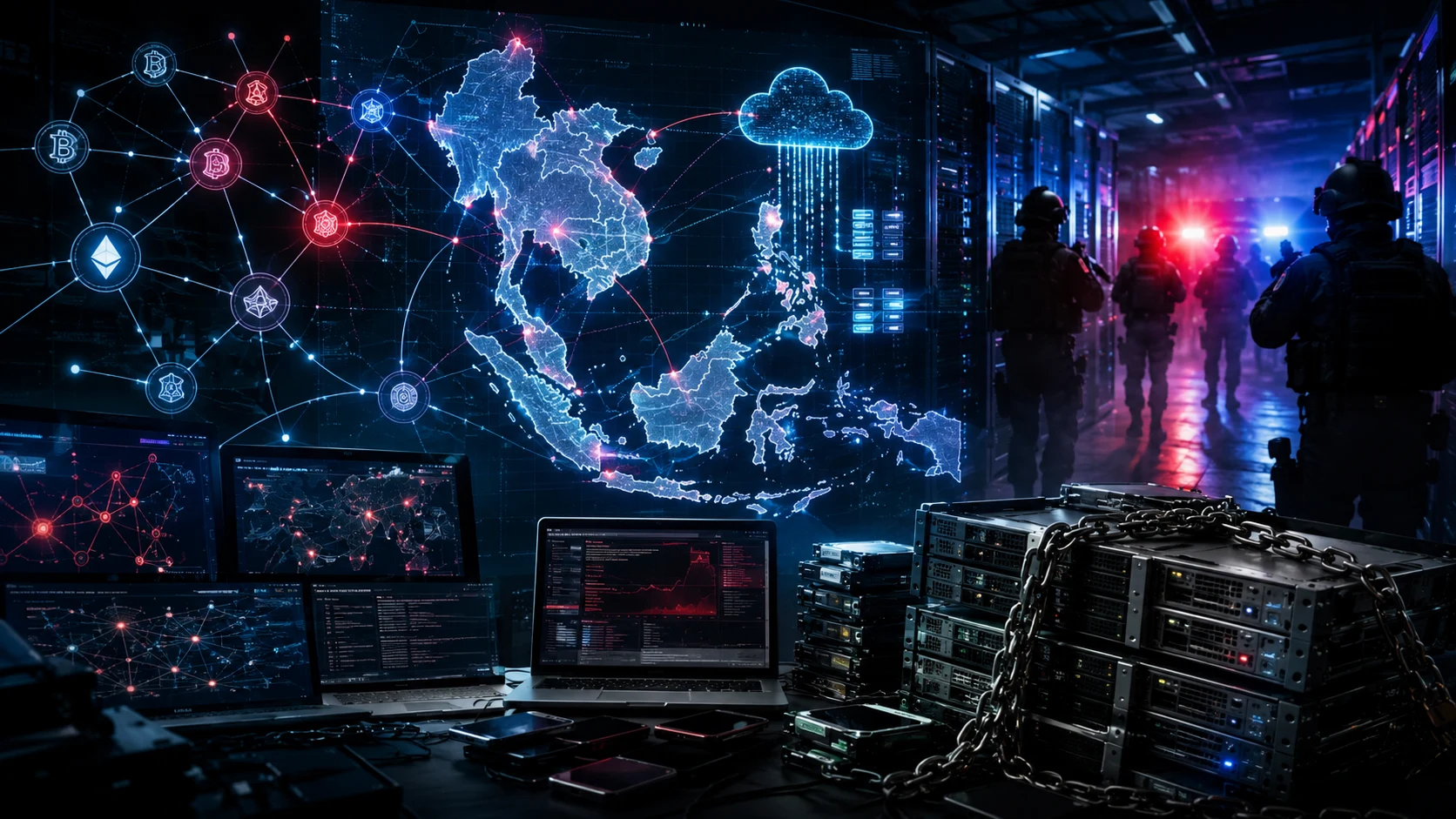
Southeast Asia cyber scams just moved from a distant online threat to a front-page enforcement story after the DOJ seized cloud infrastructure allegedly tied to scam and money-laundering services connected to Cambodia-based Huione Group. The move matters because it targets the digital plumbing behind fraud, not just the scammers sending fake investment messages to victims. For years, scam networks in the region have been described as a messy mix of crypto laundering, fake platforms, stolen identities, forced labor compounds, encrypted chat channels, and global victims who often realize the trap too late. This seizure shows that law enforcement is now chasing the backend systems that keep those schemes alive. In the bigger picture, the case is a warning that cybercrime has become less like a lone hacker story and more like a full-stack criminal economy.
The most striking part of this story is how ordinary the infrastructure sounds at first. A cloud computing account does not look dramatic in the same way as a dark web takedown page, a ransomware leak site, or a police raid photo. But in modern cybercrime, backend accounts can be the nervous system of an operation, helping organize user access, transaction flows, communications, marketplace activity, and data movement. When authorities seize that kind of infrastructure, they are not only removing a server from the internet. They are interrupting the workflow that allows fraud networks to scale, hide, and keep moving money across digital borders.
Why Southeast Asia Cyber Scams Matter Now
Southeast Asia cyber scams matter now because they are no longer isolated fraud calls or random phishing attempts. They have grown into a regional cybercrime ecosystem that can reach victims in the United States, Europe, Asia, and beyond within minutes. Many of these operations combine social engineering with cryptocurrency, making the scam feel personal at the start and nearly borderless once money begins moving. The victim may see a friendly message, a fake romance angle, or a polished investment dashboard, but behind that screen can be a layered network of recruiters, money launderers, developers, mule accounts, and platform operators. That is why a backend seizure is more than a technical headline; it is a move against the business model behind the fraud.
The DOJ action also lands at a time when cyber scams are becoming more professional, more automated, and harder for average users to spot. Fake investment platforms now mimic real fintech dashboards with clean interfaces, fake profit charts, customer support scripts, and transaction histories designed to build trust. Criminal groups can rent services, buy stolen data, access laundering networks, and use encrypted messaging channels to coordinate at scale. In some cases, victims are not only the people losing money but also trafficked workers trapped inside scam compounds and forced to run scripts against strangers online. That brutal mix of digital fraud and human exploitation makes the issue bigger than cybersecurity alone.
What the DOJ Seizure Actually Signals
The seizure signals that U.S. enforcement agencies are treating cyber scam infrastructure as a high-value target. Instead of focusing only on the final cash-out wallet or the person sending messages, authorities are moving upstream toward systems that help criminals operate as service providers. This matters because scam economies often survive by outsourcing different parts of the chain, from hosting and wallet movement to marketplace listings and identity tools. If one scam crew gets exposed, another can step in and use the same infrastructure unless that infrastructure is disrupted. By targeting backend services, the DOJ is trying to make the operating environment more expensive, less stable, and more risky for criminal networks.
This type of enforcement also reflects a shift in how governments think about digital crime. Cybercrime used to be framed mostly as a technical breach, like a hacked server, stolen password, or malware infection. Now it is increasingly viewed as an economic system with vendors, payment rails, hosting providers, brokers, recruiters, and laundering pipelines. The infrastructure behind that system can be just as valuable as the criminals sitting at keyboards. That is why the story fits naturally into Digital Crime, because it shows how online fraud depends on organized services rather than one-off tricks.
The Huione Connection and the Cybercrime Marketplace Problem
Huione Group has drawn attention because authorities have linked parts of its ecosystem to services allegedly used for laundering proceeds from cyber scams, cryptocurrency investment fraud, and other criminal activity. The concern is not just that money moved through suspicious channels. The bigger concern is that marketplaces and service layers can make crime easier for people who do not have deep technical skills. A scam operator can plug into an existing ecosystem instead of building everything from scratch. That lowers the barrier to entry and helps fraud spread faster across borders.
Cybercrime marketplaces are dangerous because they turn illegal activity into something that looks like a normal digital supply chain. One vendor may offer stolen cards, another may provide fake documents, another may help with crypto conversion, and another may sell access to compromised accounts. When these pieces connect, a fraud campaign can become much more resilient than a basic scam. Even when one actor is arrested, the tools and networks can remain available for others. That is why the DOJ seizure is important for anyone following Southeast Asia cyber scams and the way digital criminal economies evolve.
How Scam Networks Blend Social Engineering and Crypto
The most successful scam networks do not begin with code; they begin with emotion. Victims are often approached through dating apps, social platforms, messaging apps, professional networks, or random texts that feel casual enough to ignore suspicion. Over time, the scammer builds trust, introduces an investment opportunity, and directs the victim to a fake trading platform that appears legitimate. Once the victim deposits money, the dashboard may show fake gains to encourage larger transfers. The real goal is not a one-time theft but a slow extraction process that drains savings through psychological pressure.
Cryptocurrency makes these scams more difficult to unwind because funds can move quickly through wallets, exchanges, bridges, mixers, and cross-chain services. A victim may send money to what looks like a normal deposit address, but the funds can be routed through multiple hops almost instantly. Criminals use that speed to create distance between the scam and the final beneficiaries. Laundering services then become critical because stolen funds are only useful if they can be converted, hidden, or reintegrated into the financial system. This is where backend infrastructure becomes a serious enforcement target rather than a boring technical detail.
Why Cloud Infrastructure Became a Cybercrime Target
Cloud infrastructure is attractive to legitimate businesses because it is scalable, flexible, and fast to deploy. Those same qualities also make it attractive to criminal groups that need to host services, coordinate operations, and move quickly when exposed. A cloud account can support databases, admin panels, communication systems, marketplace services, automation scripts, and storage environments. Criminal actors can use fake identities, shell companies, or third-party access to reduce visibility. When authorities seize such accounts, they are targeting a layer that may support many downstream scams at once.
For cybersecurity teams, this raises a practical lesson about the shared nature of modern digital infrastructure. The same cloud platforms that power startups, banks, media companies, and SaaS tools can also be abused by criminal ecosystems. That does not mean cloud providers are the problem by default. It means identity verification, abuse detection, payment monitoring, network telemetry, and rapid legal response have become central to cloud security. In the age of cross-border cybercrime, the cloud is not just an IT resource; it is part of the battlefield.
The Human Cost Behind the Screens
One reason this story hits harder than a normal financial fraud case is the human cost behind many Southeast Asian scam operations. Reports and investigations over recent years have described people being lured by fake job ads, moved across borders, trapped in compounds, and forced to scam strangers online. These workers may be threatened, beaten, isolated, or financially trapped by debt schemes. The person messaging a victim may also be a victim in another layer of the same criminal machine. That reality makes the fight against scam compounds both a cyber issue and a human rights issue.
This layered victimhood complicates the public conversation around cyber scams. It is easy to say people should simply avoid suspicious messages, but the operations behind those messages are often built with serious coercion and organized violence. It is also easy to imagine scammers as random individuals, when many are part of industrialized systems that treat fraud like a daily quota. The DOJ seizure does not solve that entire problem, but it chips away at the infrastructure that helps those systems keep running. Every disruption can create pressure on the networks that profit from both digital deception and human exploitation.
What This Means for Businesses
For businesses, the DOJ seizure is a reminder that cybercrime risk now extends beyond direct attacks on company networks. A company may never be hacked, yet its customers, employees, brand, payment systems, or cloud workflows can still be pulled into scam activity. Attackers may impersonate executives, clone login pages, create fake job offers, abuse brand names, or target employees through investment scams that begin outside corporate channels. Once an employee is compromised personally, work accounts and devices can become the next target. That is why enterprise security teams need to treat external scam ecosystems as part of their threat landscape.
Security awareness also needs to evolve beyond basic phishing posters and annual training slides. Employees should understand how long-game social engineering works, especially when scams start through personal messaging apps and move into crypto or fake investment portals. Finance teams need clear escalation paths when unusual payment requests appear. HR teams should monitor fake recruitment campaigns that copy company branding. Legal and security teams should also know how to document abuse quickly when impersonation or fraud infrastructure appears online.
What This Means for Everyday Users
For everyday users, the lesson is not to fear every new message but to slow down when money, urgency, and secrecy enter the conversation. Many scam campaigns are designed to feel emotionally normal before they become financially dangerous. A stranger may build trust over days or weeks before mentioning crypto, trading, business opportunities, or private investment groups. Fake platforms may show profits, but those numbers are controlled by the scammer and often exist only to encourage more deposits. The safest move is to verify outside the conversation and never rely on a platform link provided by someone you just met online.
Users should also be cautious when a platform makes withdrawals difficult or adds surprise fees, taxes, verification payments, or account unlock charges. Those are classic signs of a fraud funnel that is trying to extract one more payment. A real financial platform does not require endless extra deposits before allowing withdrawals. Screenshots, wallet addresses, chat logs, transaction hashes, and website URLs should be saved if someone suspects fraud. Fast reporting can help investigators trace patterns, even when recovering funds is difficult.
The Bigger Trend: Cybercrime as a Service
The DOJ seizure fits into a bigger trend where cybercrime increasingly operates like a service economy. Ransomware already showed the world how criminal groups can split roles between developers, affiliates, negotiators, brokers, and laundering partners. Scam networks are following a similar path, with specialized providers handling fake platforms, payment movement, identity documents, traffic, scripts, and victim data. This modular model lets criminals scale faster because they do not need to own every part of the operation. It also makes enforcement more complex because the ecosystem can regenerate if only one layer is disrupted.
That is why infrastructure seizures are becoming a powerful tool. They can break shared services that many actors depend on. They can create intelligence from seized data, including account records, transaction patterns, admin activity, and communication trails. They can also send a message to service providers that ignoring criminal abuse can invite serious legal consequences. In cybercrime economics, reliability is everything, and enforcement actions are designed to make criminal infrastructure feel unreliable.
AI Could Make the Next Wave More Dangerous
Artificial intelligence adds another layer of risk to the scam economy. Scammers can use generative tools to write cleaner messages, translate scripts, imitate local slang, build fake profiles, summarize victim conversations, and personalize manipulation at scale. Voice cloning and deepfake video can make impersonation scams more convincing, especially when criminals target families, executives, or high-value individuals. AI can also help create fake websites, support chatbots, and realistic investment dashboards faster than before. This does not mean AI causes the crime, but it can lower the cost of making scams look polished and believable.
Defenders will need to use AI as well, but with discipline. Banks, exchanges, cloud providers, and security teams can use machine learning to detect unusual transaction flows, fake account clusters, repeated abuse patterns, and suspicious infrastructure changes. The challenge is balancing speed with accuracy because bad alerts can overwhelm teams while missed alerts can let criminal networks grow. Human investigators still matter because scam networks are social, financial, and technical at the same time. The best defense will combine automated detection with legal cooperation, victim reporting, and cross-border intelligence sharing.
Practical Security Insights for the New Scam Era
Organizations should start by mapping where their brand, employees, customers, and payment flows could be abused by external scam networks. That means monitoring lookalike domains, fake social accounts, spoofed job posts, copied landing pages, and suspicious support channels. It also means educating staff about relationship-based fraud, not only email-based phishing. Security teams should work with finance, HR, legal, and communications teams before an incident happens. The faster a company can identify and escalate abuse, the harder it becomes for scammers to profit from trust in that brand.
Individuals should build a simple personal rule: no investment decision should depend on pressure from a private online relationship. Any platform promising easy profits should be checked through independent search, official registration records, known app stores, and trusted financial professionals. Crypto transfers should be treated as high-risk because they are often irreversible and difficult to recover once routed through laundering channels. People should also talk openly with friends and family about scams because shame is one of the strongest weapons criminals use. The more normal it becomes to ask for a second opinion, the harder it becomes for scammers to isolate victims.
Why Enforcement Alone Will Not Be Enough
The DOJ seizure is important, but enforcement alone cannot end the scam economy. These networks survive because they exploit gaps between countries, platforms, financial systems, labor protections, and public awareness. When one domain goes down, another can appear. When one wallet is flagged, funds may move through another route. When one compound is exposed, workers and operators can be shifted elsewhere unless regional pressure is sustained.
A stronger response needs cooperation between governments, cloud providers, crypto platforms, telecom companies, banks, human rights groups, and cybersecurity researchers. Cloud providers need rapid abuse response without turning normal customers into surveillance targets. Exchanges need stronger transaction monitoring without blocking legitimate users unfairly. Governments need better ways to share evidence across borders while protecting victims and trafficked workers. Public education also needs to be modern enough to explain emotional manipulation, fake dashboards, and crypto laundering in plain language.
Conclusion: A Seizure That Sends a Bigger Message
The DOJ seizure of infrastructure tied to alleged scam and money-laundering services is not just another cyber enforcement headline. It is a signal that authorities are going after the systems that let Southeast Asia cyber scams operate like global businesses. The case highlights how cloud infrastructure, crypto rails, social engineering, marketplace services, and human exploitation can merge into one criminal machine. It also shows why cybersecurity can no longer be separated from financial crime, platform governance, and cross-border enforcement. For CyberVortixel readers, the takeaway is clear: the next phase of cyber defense is not only about blocking malware, but also about understanding the digital economies that make modern scams scalable.
The practical lesson is to treat online trust as something that must be verified, not assumed. Businesses should watch for brand abuse, train teams on long-game scams, and build faster incident escalation paths. Users should slow down when strangers introduce investments, crypto platforms, secret opportunities, or urgent payment requests. Cloud and financial platforms should keep improving abuse detection because criminal networks depend on reliable infrastructure to survive. The DOJ’s action may not end the problem overnight, but it raises the cost of doing business for scammers and pushes the global fight against cybercrime into a more serious phase.