

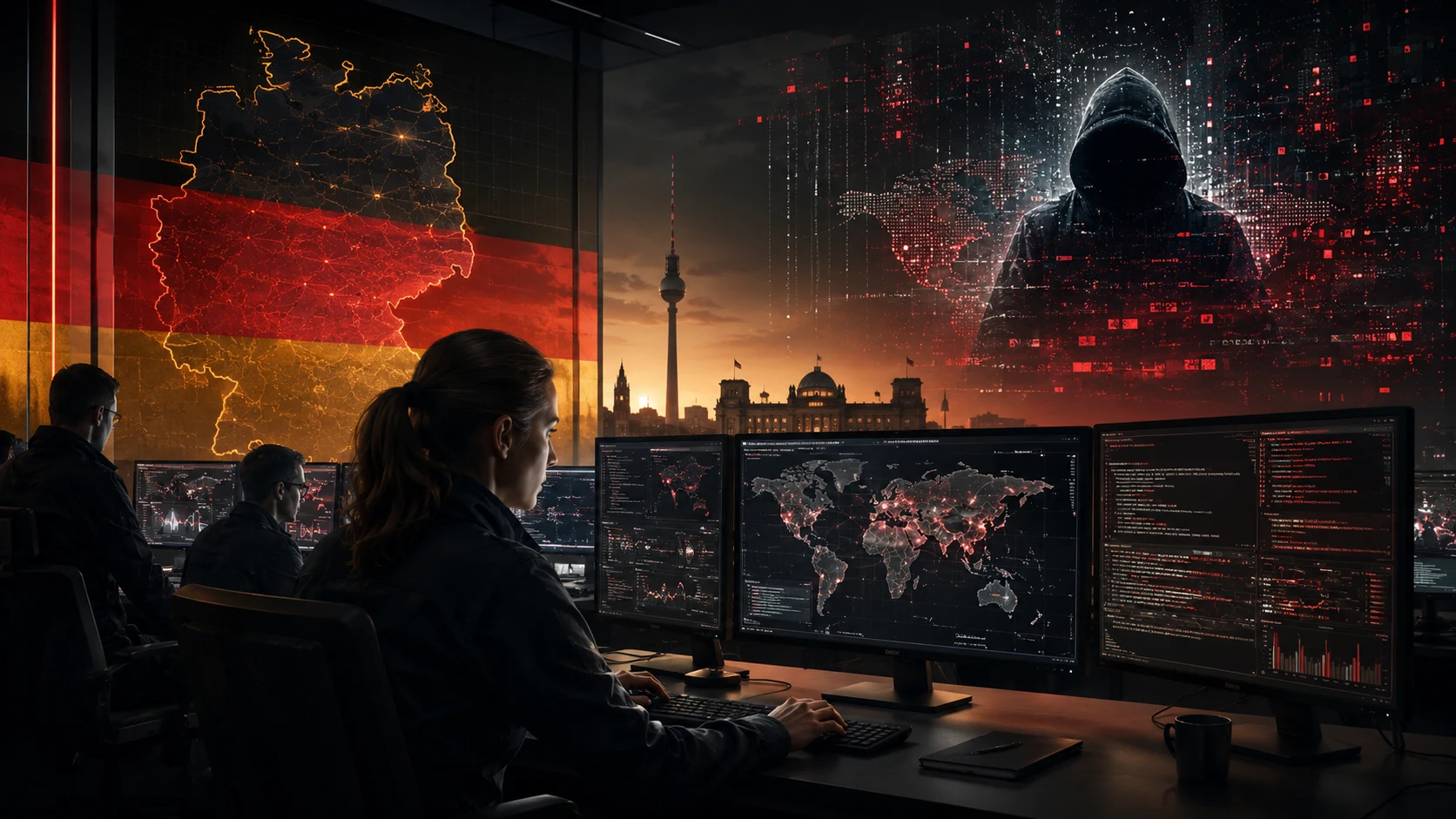
For decades, Germany’s intelligence agencies were largely expected to watch threats develop, document what happened, and warn the government before the damage spread. That cautious model reflected lessons from the country’s past, when excessive state power left scars that continue to influence German law and political culture. Now, however, the digital battlefield is moving faster than a system built mainly around observation. A proposed intelligence overhaul could allow German agencies to hack into hostile systems, erase data, disable attack tools, and disrupt foreign cyber operations before they reach their targets. The plan signals that Germany cyber defense may be entering a more active, aggressive, and politically complicated era.
The shift is not simply about giving government hackers better laptops or hiring more analysts. It represents a deeper change in how Berlin defines national defense when an attack may arrive through a compromised router, a malicious software update, a manipulated online campaign, or an invisible intrusion into critical infrastructure. Instead of waiting for hostile activity to become a completed crime, intelligence officers could potentially interfere while an operation is still being assembled. That might mean copying files from an attacker’s server, deleting stolen information, disabling malicious infrastructure, or feeding deceptive information back into a foreign campaign. In practical terms, Germany is considering whether its intelligence services should move from being digital observers to becoming operational players.
Why Germany Wants More Active Cyber Powers
The proposed changes are rooted in the growing belief that modern security threats no longer fit neatly into traditional categories. A hostile state does not need to send troops across a border to disrupt public life, weaken trust, or create economic damage. It can target government networks, energy companies, transportation systems, financial institutions, political parties, and media organizations from thousands of miles away. The same campaign may combine espionage, ransomware-style disruption, leaked documents, propaganda, and social media manipulation. Germany’s leaders increasingly describe this environment through the language of hybrid threats, where the line between cybercrime, intelligence activity, sabotage, and political pressure becomes deliberately blurry.
German officials are particularly concerned about operations linked to foreign governments, including campaigns associated with Russia. Those concerns have intensified as European countries face more frequent attempts to compromise public institutions and critical services. State-backed hacking groups often have larger budgets, longer timelines, and more sophisticated capabilities than ordinary criminal crews. They may remain inside a network for months while quietly collecting information or preparing access that could be used during a future crisis. A defensive system that responds only after the intrusion becomes visible can therefore find itself several steps behind.
This is the gap Berlin’s proposed reform is trying to close. Under the draft framework, intelligence services could receive graduated powers based on the seriousness of a threat rather than relying on one broad standard for every operation. Basic monitoring might remain appropriate for a low-level risk, while evidence of a major foreign cyber campaign could unlock more intrusive measures. Those measures could include entering an attacker’s information technology system, copying relevant data, deleting operational files, or disabling tools used to conduct the campaign. The idea is to create a legal ladder that gives authorities more options as the danger rises.
Germany Cyber Defense Could Become Proactive
The most important part of the proposal is the move toward proactive cyber defense. In the past, an intelligence service might identify a hostile server, trace its connections, and report the activity to political leaders or law enforcement. Under the proposed model, the service might also receive permission to interfere with that server or the campaign connected to it. This does not automatically mean Germany would launch destructive cyberattacks whenever suspicious activity appeared. It means officials want a legal path for limited intervention when monitoring alone cannot stop a serious threat.
Imagine that investigators discover foreign operators preparing a large-scale campaign against a German transportation network. The attackers have already compromised several systems, stored malicious tools on overseas infrastructure, and begun testing access to operational networks. Waiting until trains stop running or logistics systems fail would leave authorities reacting to damage that might have been preventable. With active powers, intelligence officers could potentially disable the tools, remove stolen credentials, disrupt command servers, or confuse the attackers about which access points still work. That kind of intervention could break the operation before the public ever notices it.
Supporters of the reform see this as a realistic response to how cyber conflict works. Attackers can replace infrastructure quickly, automate reconnaissance, and hide behind layers of compromised devices across multiple countries. Traditional investigations may take months, while a malicious payload can move through a network in minutes. The speed difference gives offensive operators a structural advantage over institutions that need to complete lengthy legal and administrative processes before acting. A more flexible intelligence framework could narrow that gap, although it would never eliminate it entirely.
The Proposal Goes Beyond Hacking Back
The phrase “hack back” sounds simple, but the German proposal appears broader and more carefully structured than a basic digital counterattack policy. It could allow agencies to disrupt infrastructure, collect or remove data, and deliberately deceive foreign operators under defined threat conditions. Deception may involve feeding an adversary misleading technical signals, false operational details, or controlled information designed to expose the people behind a campaign. Intelligence agencies have used deception for generations, but digital systems allow it to happen at a different scale and speed. A fake credential, fabricated server environment, or planted document can reveal how attackers operate without immediately alerting them.
The draft also seeks to place domestic and foreign intelligence operations within a more unified legal framework. Germany’s internal security service and foreign intelligence service have historically worked under different mandates, even when a digital threat moved between domestic networks and overseas infrastructure. That separation becomes difficult to manage when attackers route traffic through dozens of countries and use compromised German devices as part of a foreign-led operation. A campaign may begin abroad, touch a cloud server in another European country, pass through a home router in Germany, and eventually target a federal agency. Modernizing the rules could make cooperation easier, but it also raises questions about where one agency’s authority ends and another’s begins.
Another important element involves the use of government spyware for online searches and source telecommunications surveillance. Source surveillance generally focuses on communications before they are encrypted or after they are decrypted on a device. This capability can help investigators access conversations that would otherwise remain unreadable while moving through encrypted services. At the same time, placing spyware on a device is among the most intrusive actions a government can take because it may expose far more than a single conversation. Clear limits, technical safeguards, and independent authorization will be essential if these tools become part of the new system.
Germany’s History Makes the Debate Different
Germany’s caution around intelligence power did not appear by accident. The country’s postwar legal system was built with strong protections against the concentration and abuse of state surveillance. Memories of the Nazi security apparatus and East Germany’s Stasi continue to shape public attitudes toward monitoring, informants, secret files, and government intrusion. As a result, German intelligence agencies generally operate under tighter restrictions than many of their international partners. Any proposal that expands covert authority will therefore face scrutiny that goes far beyond technical cybersecurity questions.
This historical context creates a real tension rather than an easy political choice. A government that lacks the tools to stop modern cyber operations may fail to protect citizens, businesses, and democratic institutions. A government that receives overly broad powers may create systems that can be misused, expanded, or normalized over time. Both risks deserve serious attention, and pretending that only one of them matters would weaken the debate. The challenge is to develop capabilities strong enough to confront hostile actors while keeping those capabilities inside a transparent legal structure.
The proposed use of confidential informants shows how sensitive that balance may become. The draft reportedly explains informant rules in greater detail and includes exceptional circumstances in which people as young as 16 could be used to help uncover the most serious threats. Such cases may involve extremist networks, espionage circles, or other environments where younger individuals possess access that adults cannot easily obtain. Even if the authority is limited to extraordinary situations, involving minors in covert intelligence work creates obvious ethical and safety concerns. Lawmakers will need to examine whether the proposed safeguards are strong enough to prevent pressure, exploitation, or long-term harm.
Oversight Will Decide Whether the Model Works
Expanding intelligence authority without expanding accountability would make the proposal much harder to defend. The draft attempts to address that issue through a new Independent Control Council that would bring several oversight functions together. The council could combine responsibilities related to wiretap approval, data protection, and authorization for highly intrusive surveillance. The most sensitive measures, including long-term undercover activity and surveillance inside private homes, would require advance approval. Centralized oversight could reduce confusion, although its effectiveness will depend on independence, staffing, technical expertise, and access to complete information.
Cyber operations are especially difficult to oversee because their consequences may not remain inside a single system. Deleting a file from a hostile server sounds targeted until that server also supports unrelated customers, public services, or evidence needed for a criminal investigation. Disabling malicious infrastructure may interrupt an attack, but it could also alert the operators and destroy valuable intelligence about their network. A deceptive operation might protect one target while encouraging attackers to shift toward another organization. Oversight bodies must therefore evaluate not only whether an action is legal, but whether it is technically proportionate and strategically sensible.
Attribution creates another layer of risk. A server used in an attack may belong to the attacker, but it may also be an innocent machine that was compromised months earlier. Infrastructure can be rented with stolen identities, purchased through intermediaries, or hidden behind commercial privacy services. Even state-backed groups frequently use criminal tools and hijacked consumer devices to blur their origins. Acting too quickly against the wrong system could damage innocent parties, complicate diplomatic relationships, or give an adversary a propaganda opportunity.
Private Companies May Face New Obligations
The reform would not affect intelligence agencies alone. Telecommunications providers, digital platforms, transportation operators, financial intermediaries, and other businesses could receive binding secret orders to disclose relevant information. Companies that refuse to cooperate could face inspections and significant financial penalties, reportedly reaching as high as €1 million under the intelligence proposal. For businesses, this creates a new compliance landscape in which legal, security, privacy, and executive teams may need to coordinate quickly under strict confidentiality. The operational burden could be especially heavy for organizations that have never viewed themselves as part of national security infrastructure.
Secret disclosure orders also create difficult questions for multinational companies. A platform headquartered outside Germany may hold data in several jurisdictions, each with different privacy laws and government access requirements. Cooperating with one country’s intelligence order could potentially conflict with obligations imposed somewhere else. Cloud providers may have to determine whether an order applies to customer content, technical metadata, access logs, or infrastructure located outside German territory. These conflicts are not unique to Germany, but broader intelligence powers could make them more frequent and harder to resolve.
Enterprise security teams should pay attention even before the proposal becomes law. A more active government response may change how major incidents are investigated, how evidence is preserved, and how companies communicate with authorities. Businesses could find themselves asked to maintain access logs longer, isolate infrastructure without destroying it, or support a coordinated disruption operation. Incident response plans that assume law enforcement will only arrive after an attack may no longer match the emerging model. Organizations operating in Germany should begin reviewing these issues with teams responsible for cybersecurity, privacy, legal compliance, and business continuity.
What This Means for Europe’s Cyber Strategy
Germany’s direction could influence the wider European debate over offensive and defensive cyber operations. European governments already cooperate on intelligence sharing, sanctions, criminal investigations, infrastructure protection, and coordinated responses to state-backed campaigns. However, their legal authorities and political comfort levels vary widely. If Germany adopts a carefully supervised model for active disruption, other countries may use parts of it as a reference. If the system produces controversy or unintended damage, it could instead become a warning about moving too quickly.
The proposal also reflects a broader realization that cyber defense cannot rely only on stronger firewalls and faster software patches. Those controls remain essential, but they do not address every threat posed by a determined foreign intelligence service. Some campaigns target the people around a system through coercion, recruitment, misinformation, or stolen identities. Others exploit global infrastructure that sits beyond the legal reach of the organization being attacked. Active disruption gives governments another option between issuing a warning and escalating toward a traditional military response.
That middle ground may become increasingly important as AI accelerates both offensive and defensive security work. Attackers can use automated tools to scan large numbers of systems, customize phishing messages, analyze stolen documents, and search for vulnerable software. Defenders can use similar technology to identify suspicious behavior and prioritize threats, but public institutions often face stricter operational limits. Intelligence reform may help governments respond more quickly, yet faster tools also increase the danger of acting on incomplete or misleading information. Human review and legal accountability cannot become optional simply because machines can recommend an action in seconds.
Practical Lessons for Security Leaders
For security leaders, the biggest lesson is that cyber incidents are becoming matters of national strategy rather than isolated technical failures. A company targeted by a state-backed group may suddenly need to work with regulators, intelligence agencies, police, industry partners, and foreign authorities. Its logs and compromised systems may contain evidence needed for a larger disruption campaign. A rushed cleanup could destroy that evidence, while a delayed response could leave the business exposed. Incident plans should define who has authority to communicate with government agencies and how the organization will preserve data under pressure.
Companies should also improve their understanding of infrastructure dependencies. An attacker may never target the organization directly if compromising a software supplier, telecommunications provider, or managed service delivers the same access. Mapping those relationships helps teams identify where a wider government-led intervention could affect normal operations. It also makes it easier to prepare alternative communication methods, backup services, and recovery procedures. Resilience matters because even a successful disruption of hostile infrastructure can produce temporary instability across connected systems.
Another practical step is to separate confirmed facts from assumptions during an incident. When leaders believe a foreign government is responsible, political pressure can make uncertain evidence sound more conclusive than it really is. Security teams should document confidence levels, alternative explanations, and the limitations of available telemetry. That discipline supports better decisions whether the response remains internal or involves an intelligence agency. It also reduces the risk that public statements create legal or diplomatic consequences before attribution is properly established.
The Risks of an Offensive Cyber Posture
Active cyber defense offers clear advantages, but it also creates the possibility of escalation. A foreign government may interpret the deletion of data or disruption of infrastructure as an attack rather than a defensive measure. It could respond against German networks, pressure German companies operating abroad, or use the event to justify its own aggressive actions. Because cyber operations are often secret, the public may never see the evidence that officials used to authorize the intervention. That secrecy can be operationally necessary while still making democratic accountability more difficult.
There is also a danger that exceptional powers gradually become normal tools. A capability introduced for a large-scale state-sponsored attack might later be proposed for lower-level crime, political extremism, or routine investigations. Legal thresholds can be rewritten, while emergency interpretations sometimes survive long after the emergency ends. Strong sunset reviews, reporting requirements, judicial involvement, and parliamentary scrutiny can help limit that drift. Technical audit systems should also record who authorized an operation, what tools were used, which systems were touched, and whether the action stayed within its approved scope.
Governments must also protect the offensive tools they develop. An exploit created to access a hostile system may later leak, be stolen, or be independently discovered by criminals. Stockpiling unknown software vulnerabilities can provide short-term intelligence value while leaving citizens and businesses exposed to the same flaw. Germany will need a clear process for deciding when to use a vulnerability secretly and when to disclose it so the affected vendor can issue a patch. Without that balance, a program designed to improve national security could unintentionally preserve weaknesses across the digital economy.
A Turning Point, Not a Finished Policy
It is important to remember that the intelligence overhaul is a proposal rather than a completed transformation. Draft laws can change significantly as ministries, lawmakers, courts, civil society groups, industry representatives, and privacy advocates examine the details. Definitions may be narrowed, authorization requirements may become stricter, and some controversial provisions may be removed entirely. The final shape will determine whether Germany gains a focused cyber capability or a much broader surveillance system. Political debate will be especially intense because the proposal touches security, privacy, foreign policy, technology, and historical memory at the same time.
Even so, the direction of travel is already clear. Germany no longer believes that observing hostile digital operations is always enough to protect a highly connected society. Its government is exploring a model in which intelligence agencies can intervene before a foreign campaign becomes a national crisis. The success of that model will depend less on dramatic language about striking back and more on precise legal thresholds, accurate attribution, technical restraint, and genuinely independent oversight. Offensive capability without those foundations would create new risks instead of solving old ones.
Conclusion: Germany Redefines Digital Defense
Germany is approaching a major decision about what national defense should look like in an age of hidden networks, remote sabotage, and state-backed hacking. The proposed reform could give intelligence services the authority to enter hostile systems, disrupt attack infrastructure, remove data, and deceive foreign operators under serious threat conditions. Those tools may help stop campaigns before hospitals, transportation networks, businesses, or public institutions suffer lasting damage. They could also expand state power in ways that demand exceptional legal and democratic safeguards. The future of Germany cyber defense will ultimately be judged not only by whether it can strike back, but by whether it can do so accurately, proportionately, and without abandoning the principles it was created to protect.