

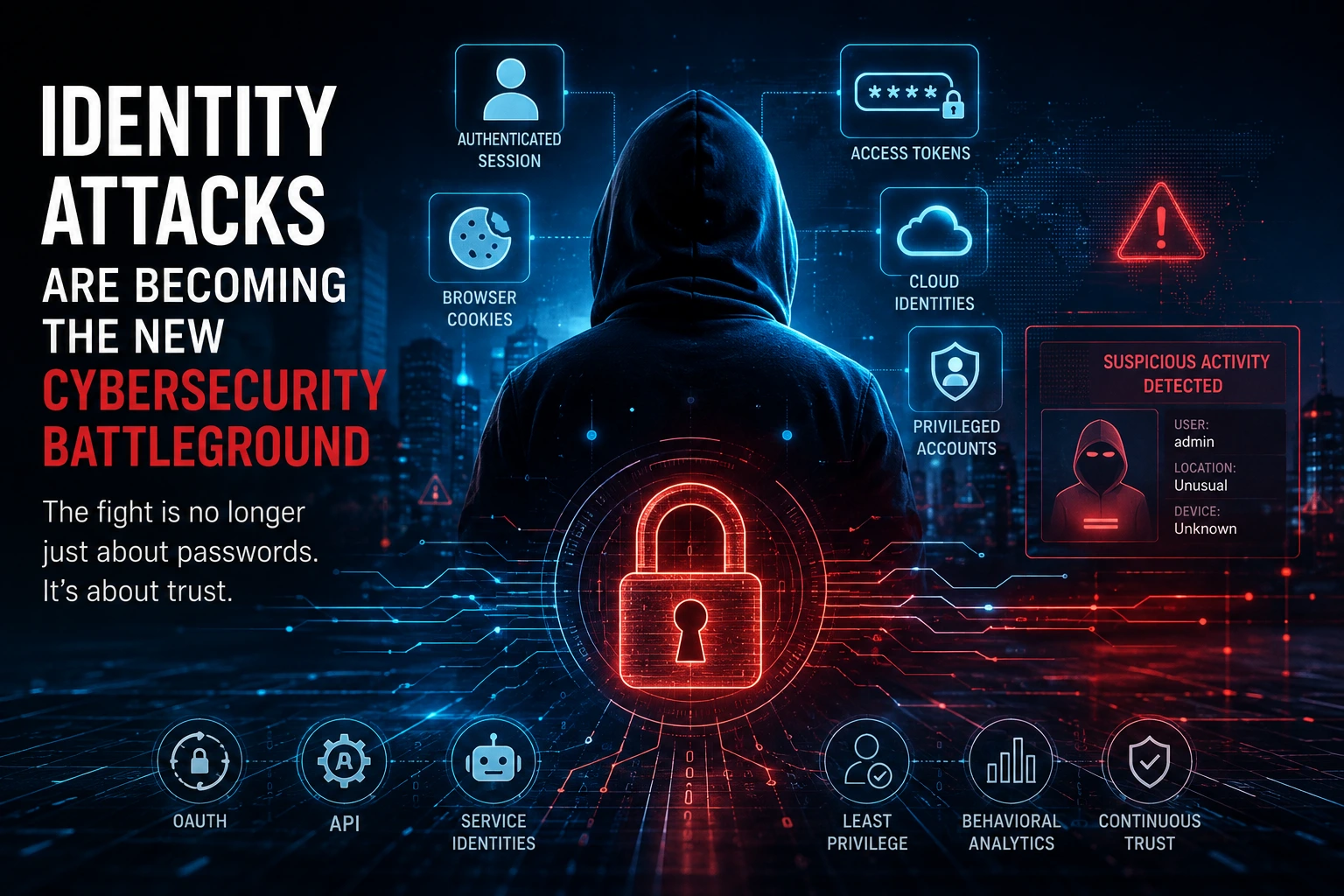
A successful login used to be treated as a reassuring moment. The password was correct, the second factor was accepted, and the system could move on to the next question. That assumption is becoming increasingly fragile. An authenticated session can now be legitimate from the platform’s perspective while still being controlled, redirected, or abused by someone who should never have had access in the first place.
That tension sits at the center of the rise in identity attacks. The most important shift is not that attackers have suddenly discovered passwords, credentials, or account takeover. Those have been part of offensive playbooks for years. What is changing is the value attackers place on everything that exists after authentication: trusted sessions, browser cookies, OAuth tokens, privileged identities, cloud roles, API keys, service accounts, and the permissions attached to them.
This changes the security problem in a subtle but important way. Defenders are no longer only asking whether someone can prove who they are. They increasingly have to ask whether the activity performed by an authenticated identity still matches the person, application, workload, or service that identity is supposed to represent. That is a much harder question because malicious behavior can begin after all the traditional authentication checks have already passed.
Identity Attacks Are Moving Beyond the Password
Passwords remain useful to attackers because passwords still unlock access. But the modern identity stack is far larger than a username and a secret string. A single employee may authenticate through a central identity provider, receive a browser session, access several cloud applications through single sign-on, authorize third-party tools through OAuth, interact with internal APIs, and inherit permissions based on role, group membership, device trust, location, and organizational policy.
Each of those steps creates something valuable. A session cookie can represent a previously authenticated browser. An access token can authorize an application to interact with a service without requiring the user to type a password again. A cloud identity can inherit permissions across infrastructure that may contain data, secrets, workloads, or administrative functions. A service account can perform repetitive automated work without ever behaving like a human user.
Attackers do not necessarily need to defeat every security control individually if they can obtain one of those trusted artifacts. In many cases, the more interesting target is not the credential used to establish trust but the trust that exists afterward. This is one reason identity security is becoming increasingly central to broader cybersecurity strategy. Once authenticated access becomes transferable, reusable, or difficult to distinguish from legitimate behavior, the security boundary becomes less obvious.
The old model imagined a relatively clean transition from outside to inside. The attacker had to cross a perimeter, steal credentials, exploit a vulnerability, or defeat a login mechanism. Modern environments are more fluid. Employees work remotely, applications depend on cloud identity providers, contractors receive temporary access, workloads authenticate to other workloads, and users move between SaaS platforms without repeatedly proving who they are. Convenience depends on persistent trust. Attackers increasingly look for ways to inherit that trust.
Why Authenticated Sessions Have Become So Valuable
From an attacker’s perspective, trusted access can be more useful than raw credentials because it may place malicious activity downstream from the strongest authentication controls. A password can trigger suspicious-login checks. A new device may generate an alert. Multi-factor authentication can stop some credential-based attempts. But an already authenticated session may appear, at least initially, to belong to a user who has successfully completed those challenges.
This does not make multi-factor authentication irrelevant. Far from it. Strong authentication remains one of the most important controls against many forms of account compromise. The problem is that authentication is a moment, while trust often persists for much longer. Security systems need to protect both the process that establishes trust and the artifacts that maintain it afterward.
Browser sessions illustrate the issue clearly. Modern applications are designed to keep users signed in because constant reauthentication creates friction. That persistence is convenient for legitimate users, but it also makes session theft and session hijacking a valuable path for attackers.
OAuth and similar authorization frameworks introduce another layer. Users increasingly grant applications permission to access mailboxes, files, calendars, cloud data, developer platforms, or collaboration tools. These authorization relationships are powerful precisely because they reduce the need to repeatedly handle passwords. That same design means organizations need visibility into which applications have access, which permissions they hold, how long those permissions persist, and whether the behavior associated with them still makes sense.
The broader lesson is simple: authentication cannot be treated as the end of the security decision. It is the beginning of a continuing trust relationship.
Cloud Identity Has Expanded the Attack Surface
Cloud infrastructure has made identity even more important because access is frequently defined through permissions rather than physical network location. A user, application, or workload can interact with resources based on what an identity is allowed to do. That model is extremely flexible, but it also means identity becomes a control plane for a large part of the environment.
A compromised endpoint might once have been viewed primarily as a device problem. In a cloud-heavy organization, the more significant consequence may be what identities, tokens, credentials, secrets, or administrative capabilities that endpoint can reach. The device is only one part of the story. The permissions attached to identities can determine how far an incident travels.
This is where identity-based lateral movement becomes important. Traditional lateral movement often evokes images of attackers moving from one machine to another across an internal network. The modern version can look different. Movement may occur through accounts, cloud roles, application permissions, federation relationships, or access to shared administrative platforms. The path is not always device-to-device. Sometimes it is identity-to-service, service-to-cloud resource, or compromised user-to-privileged role.
The attack surface expands further when organizations operate multiple cloud platforms, SaaS services, identity providers, and internal applications at the same time. Permissions accumulate. Temporary access becomes permanent. Old integrations remain authorized. Employees change roles without losing every entitlement associated with the previous one. Service identities are created for projects and remain active long after those projects change.
The issue is not that cloud identity is inherently insecure. The issue is that identity has become one of the main ways modern organizations express trust, and complex trust relationships are difficult to continuously validate.
The Quiet Risk of Machine and Service Identities
Human users attract attention because they are familiar. Employees have usernames, passwords, job titles, managers, devices, and recognizable work patterns. Machine identities are less intuitive. APIs, scripts, automated workloads, containers, cloud services, build systems, integration tools, and background processes may all need credentials or tokens to communicate with other systems.
These identities can become especially sensitive because automation often requires persistent access. A service may need to retrieve data every few minutes. A deployment pipeline may need permission to push changes. An application may need access to a database, storage system, messaging service, or external API. Those relationships are normal and necessary, but the permissions involved can be substantial.
Machine identities also behave differently from people. A human user logging in from an unusual location at an unusual time may trigger suspicion. A service account may operate continuously, across multiple systems, without anything resembling a normal human schedule. Detecting misuse therefore requires understanding what the machine identity is expected to do, not simply applying human-user assumptions to it.
This matters because organizations are steadily becoming more automated. More infrastructure is managed through APIs. More applications exchange data without human intervention. More security tools themselves rely on machine-to-machine access. As automation expands, the number of non-human identities can grow rapidly, and the distinction between identity management and security engineering becomes increasingly difficult to maintain.
Why Traditional Endpoint Thinking Is Not Enough
Endpoint security remains essential. Devices still execute malicious code, store sensitive information, interact with users, and provide attackers with footholds. Endpoint detection and response platforms can observe processes, files, command execution, and suspicious behavior that would otherwise be difficult to see. But identity attacks expose a limitation in any security strategy that assumes the endpoint is always the most important place to detect compromise.
What happens when the attacker does not need to deploy obvious malware? What happens when the suspicious activity occurs through a legitimate browser session, an approved SaaS application, a valid cloud token, or an authorized account? The endpoint may still provide useful evidence, but the decisive activity could occur elsewhere. Infostealers provide the opposite example: malware running on an endpoint can become an identity attack when it extracts credentials, browser cookies, or authenticated-session data that attackers can reuse elsewhere.
This is one reason security teams increasingly need to correlate information across multiple layers. Authentication events provide one view. Endpoint telemetry provides another. Cloud logs, SaaS activity, network behavior, authorization changes, privilege use, device posture, and application access add more context. None of these signals is automatically sufficient by itself.
The goal is not to collect every possible log and hope that volume equals security. The goal is to understand whether a trusted identity is behaving in a way consistent with its expected role. That shifts detection away from a simple question of “Was access granted?” toward a more difficult one: “Does this activity still make sense after access was granted?”
Legitimate Activity Is Becoming Harder to Trust
Many security controls are effective because malicious behavior differs from normal behavior. Malware may launch unusual processes. Network attacks may generate abnormal traffic. Password spraying may create repeated failed logins. A new administrative account may appear unexpectedly. The clearer the difference, the easier it can be to build useful detection logic.
Identity abuse complicates this because the attacker’s advantage can come from looking ordinary. A valid account accessing a valid application is not automatically suspicious. An OAuth-enabled application requesting data may be performing exactly the action it was authorized to perform. A privileged identity executing an administrative function may simply be doing its job.
This turns context into a major part of detection. Is the employee accessing information they normally use? Is the session behaving differently from previous sessions? Did a privilege change occur shortly before unusual activity? Is a service identity interacting with resources outside its normal scope? Is a previously quiet account suddenly touching sensitive systems?
Behavioral detection can help answer those questions, but it should not be treated as magic. Organizations vary dramatically, and legitimate behavior can be messy. Employees travel. Developers experiment. Administrators perform unusual maintenance. Applications change. Automated processes generate spikes in activity. A detection system that assumes every deviation is malicious will create noise faster than security teams can investigate it.
The useful approach is more nuanced: combine behavior with identity context, privilege, asset sensitivity, device trust, historical patterns, and the sequence of events surrounding the activity. The more identity becomes central to the attack surface, the more defenders need to understand not just who an account claims to represent but what that identity should reasonably be doing.
Privilege Is the Real Multiplier
Not every compromised identity creates the same level of risk. Privilege changes the equation dramatically. A low-access account may expose limited information. A privileged identity may alter infrastructure, modify access controls, create new credentials, access sensitive repositories, or influence many other accounts.
This is why least privilege remains such an important principle even as the threat landscape changes. The purpose is not simply to satisfy a compliance requirement. Limiting permissions reduces the amount of damage any single identity can cause if it becomes compromised, misused, or misconfigured.
The difficult part is maintaining least privilege over time. Organizations grow. Teams change. Employees switch responsibilities. Temporary projects become permanent systems. Emergency permissions are granted and forgotten. Service accounts accumulate new capabilities because removing old access feels risky. Administrative roles expand because broad permissions are easier to manage than precise ones.
This creates what might be called permission gravity: access tends to accumulate unless someone deliberately removes it. Attackers benefit from that accumulation because an identity can become more valuable than its original purpose would suggest. A compromised account may not look important on an organizational chart while still holding permissions inherited from years of changing responsibilities.
Authentication Still Matters, but the Goal Is Changing
The growth of identity-centered attacks does not mean the industry should abandon stronger authentication. Phishing-resistant authentication, hardware-backed credentials, modern multi-factor methods, and better account recovery processes can significantly reduce opportunities for attackers. The mistake would be assuming that stronger login security solves the entire identity problem. That distinction is especially important as techniques such as device code phishing attempt to abuse legitimate authentication and authorization workflows rather than simply guessing passwords.
Authentication answers a narrow question: has this user or system provided enough evidence to establish access under current policy? It cannot guarantee that the device remains trustworthy, that a session will never be exposed, that an authorized application will always behave safely, or that the identity itself has only the permissions it actually needs.
This is why session management deserves more attention. Organizations need sensible expiration policies, mechanisms to revoke access quickly, visibility into active sessions, and the ability to respond when the risk profile of an identity changes. Long-lived trust may improve usability, but it also increases the window in which compromised access can remain valuable.
The same logic applies to tokens and application authorizations. Access should not survive forever simply because it was once legitimate. Trust needs an expiration date, a scope, and a reason to continue existing.
IAM and Cybersecurity Are Starting to Converge
Identity and access management was historically treated by many organizations as an administrative discipline. It handled provisioning, role assignment, authentication, password policies, and access lifecycle management. Security teams focused on threats, vulnerabilities, malware, incident response, and network defense. That division is becoming increasingly artificial.
If attackers are targeting identities, permissions, sessions, and authorization relationships, then IAM decisions are security decisions. A poorly scoped role can become an attack path. An abandoned account can become persistence. An overprivileged service identity can become lateral movement.
The same principle applies to enterprise identity infrastructure such as Active Directory and domain controllers, where weaknesses can turn identity systems themselves into high-value attack paths. An old application authorization can become an unexpected route into sensitive data.
The convergence works in the other direction as well. Security teams need IAM context to understand whether activity is meaningful. A log showing that an account accessed a system says little without knowing who owns the account, what role it serves, which permissions it holds, whether those permissions recently changed, and whether the access is normal for that identity.
Modern identity security therefore becomes a shared problem across IAM, security operations, cloud security, endpoint teams, developers, platform engineers, and application owners. The boundaries between those disciplines are still useful organizationally, but attackers have no reason to respect them.
Defenders Need to Protect the Trust Chain
The strongest response to identity attacks is not a single product category. It is a more disciplined approach to how trust is established, maintained, monitored, and revoked. That begins with stronger authentication but continues through the entire life of an identity.
Phishing-resistant authentication can make certain forms of credential theft less useful. Least privilege can reduce the consequences of a compromised identity. Better session controls can shorten the useful life of stolen access. Identity monitoring can surface unusual behavior. Privileged access management can limit powerful administrative capabilities. Stronger application governance can reduce the number of unnecessary OAuth grants and integrations.
Machine identities require the same discipline. Secrets should not be treated as permanent simply because no human types them. Service permissions should be scoped carefully. Access should be rotated, monitored, and removed when no longer needed. Automation should make identity management more reliable, not make excessive trust invisible.
The operational challenge is connecting these controls. A security team may have excellent endpoint protection while identity permissions remain poorly understood. An organization may require strong MFA while allowing sessions to persist far longer than necessary. Cloud roles may be carefully managed while third-party application access remains largely unreviewed.
Attackers often look for the weakest transition between security layers. Identity security is increasingly about preventing those transitions from becoming invisible.
The Bigger Shift Is From Access to Continuous Trust
The most important change behind modern identity attacks is philosophical as much as technical. Security has traditionally placed enormous emphasis on access decisions. Is this password correct? Is the device approved? Did the user complete the second factor? Does the account belong to the correct group?
Those questions still matter, but they assume trust can be established at a particular moment and then safely carried forward. Modern environments make that assumption increasingly difficult to defend. Devices change state. Users change roles. Tokens persist. Applications gain permissions. Sessions move between contexts. Infrastructure is created and destroyed automatically. A legitimate identity can become risky without the identity itself visibly changing.
Security therefore has to become more continuous. Trust should be evaluated throughout the life of access rather than concentrated entirely at login. That does not mean forcing users to repeatedly authenticate every few minutes or turning every action into a security challenge. It means building systems that can recognize when the context surrounding trusted access has changed enough to justify additional scrutiny.
This is one of the deeper reasons identity has become such a significant cybersecurity battleground. The industry spent years improving the front door. Attackers are increasingly interested in what happens after the door opens.
What Comes Next for Identity Security
Identity will likely become even more complicated as organizations adopt more automation, cloud infrastructure, AI agents, APIs, SaaS platforms, and machine-to-machine communication. The number of identities in an environment may grow faster than the number of employees. Many of those identities will operate continuously and interact with sensitive systems without direct human supervision.
That creates a new problem for defenders: understanding intention at machine speed. An AI agent may legitimately access several tools, retrieve information, call APIs, and perform actions on behalf of a user. A compromised or poorly constrained agent could potentially produce activity that looks very similar to normal automation. The same fundamental question appears again: the identity is authenticated, but can its behavior still be trusted?
Security teams will therefore need better visibility into relationships between identities, permissions, applications, workloads, devices, and sensitive resources. Static account inventories will not be enough. The useful security picture is increasingly a graph of who and what can access what, under which conditions, and how those relationships change over time.
This does not mean every organization needs a radically new architecture tomorrow. Many improvements are straightforward in principle: remove unnecessary access, shorten the life of sensitive credentials, review privileged identities, monitor unusual session behavior, adopt stronger authentication, and treat machine identities with the same seriousness as human ones.
The harder work is cultural. Organizations need to stop thinking of identity as something that becomes safe once authentication succeeds. Authentication proves something at a moment in time. Security has to protect what happens next.
Identity Is Becoming the Security Perimeter
The phrase “identity is the new perimeter” has been repeated often enough to risk becoming another security slogan. Yet the underlying idea is becoming more concrete. Employees are distributed. Applications live across multiple cloud environments. Data moves through SaaS platforms. Workloads communicate through APIs. Traditional network boundaries still matter, but they no longer describe the full shape of organizational trust.
Identity increasingly determines who can reach data, infrastructure, applications, and administrative capabilities. That makes identity one of the most valuable places for attackers to apply pressure and one of the most important places for defenders to reduce uncertainty.
The next phase of identity security is therefore not simply about preventing password theft. It is about preventing legitimate access from becoming a disguise for malicious activity. It is about understanding when permissions are too broad, when sessions should no longer be trusted, when machine identities are behaving outside their purpose, and when authenticated behavior stops matching the identity behind it.
Identity attacks are becoming a defining cybersecurity problem because they challenge one of the most basic assumptions in digital security: that authentication creates certainty. Increasingly, it creates only a starting point. The more important question begins afterward.